

The Ticino-based company Trickster-p presents Common Land, an unconventional show that could be described as a “journey” through the dimensions that make up our small world. The audience explores a constantly changing landscape: a collective but also highly individual experience, not a single perspective but a constellation of views. From 25 February to 4 March 2026 with two performances (weekdays at 6pm and 8.30pm - weekends at 2pm and 5pm) at the Teatrostudio del LAC in Lugano. This is a challenge for LAC Lugano Arte e Cultura, whose objectives include “finding new areas of research, art forms capable of shifting perspectives and supporting independent companies in order to guarantee their autonomy”, as explained by the artistic director of performing arts, Carmelo Rifici, at the press conference on 10 February 2026.
But what does it mean to be an independent artist? We asked director Cristina Galbiati.
What do you want to explore? Over the years, my practice has moved away from the concept of theatre in the strict sense to investigate possible cross-cutting forms of expression that are the result of a mixture of heterogeneous artistic tools. An invitation to the viewer to open up their perceptual spaces and create their own reality in a borderland between inner and outer vision. Common Land, for example, is a time we inhabit as humans, thinking we can control it, but it is also experienced by other elements that have different perspectives from ours.
You say that Common Land is a journey that invites us to look beyond what we see and feel what often escapes our everyday gaze. So, is it an invitation to the human mind to open up and discover the non-human as well?
Common Land is a show that explores time and space and how they are inhabited and transformed by humans and non-humans. The dramaturgical journey is guided by time itself, conceived as a series of Chinese boxes: from the grand narrative of history, which we study in books and which sometimes directly affects our lives, to the individual time of life, made up of small and large moments, to the stories of all forms of non-human life that share spaces and times with us that are often invisible to our perception. We work to enable viewers to grasp these connections, perceive the network of relationships that spans the world, and reflect on how every presence, human or non-human, contributes to transforming the space and time we inhabit. In this sense.
Among his most significant works are performances and installations translated into numerous languages and presented in over 30 countries in Europe, Asia, Australia, North America and South America. A director of the world. And for Switzerland?
Alongside my artistic work, I coordinate and curate numerous national and international projects. Since 2020, I have been a member of the Cultural Advisory Commission of the Canton of Ticino as chair of the Performing Arts Subcommittee, and since 2021 I have been co-chair of the national association t. Professioni dello spettacolo Svizzera. In 2017, together with my artistic partner, Ilija Luginbühl, I received the Swiss Theatre Award for the originality of our artistic research. From 2024 to 2026, Trickster-p, of which I am the artistic director, will be the resident company at LAC Lugano Arte e Cultura - Lugano.
Trickster-p is supported by a three-year agreement involving Pro Helvetia, the Canton of Ticino, the City of Lugano, the Municipality of Novazzano and LAC - Lugano Arte e Cultura. These agreements, of which there are only 12 in the whole of Switzerland, bring together local and national partners to support companies of international importance. A support network to maintain independent art?
In our case, there is a unique aspect: a theatre is also a party to the agreement, creating a rare and virtuous collaboration. We are proud of this recognition, which allows us to consolidate our work and constantly improve its quality. This support also opens up new possibilities for us beyond the canton. The Common Land project, for example, involved Theater Casino. Zug, Theater Stadelhofen Zurich, Theater ROXY Basel, Triennale Milano Teatro, TAK Theater Liechtenstein, as well as the Canton of Basel, the Canton of Zug and the City of Zug.
So culture also generates economic returns? Is it possible to quantify this?
Of course, we are an example of how investing in culture brings concrete benefits to the region: every franc invested generates at least 2.5 francs in economic activity. Culture, especially independent culture, needs support: it is not only a social and cohesive value, it is also a real economic driver. Deluxu.it Magazine - Copyright
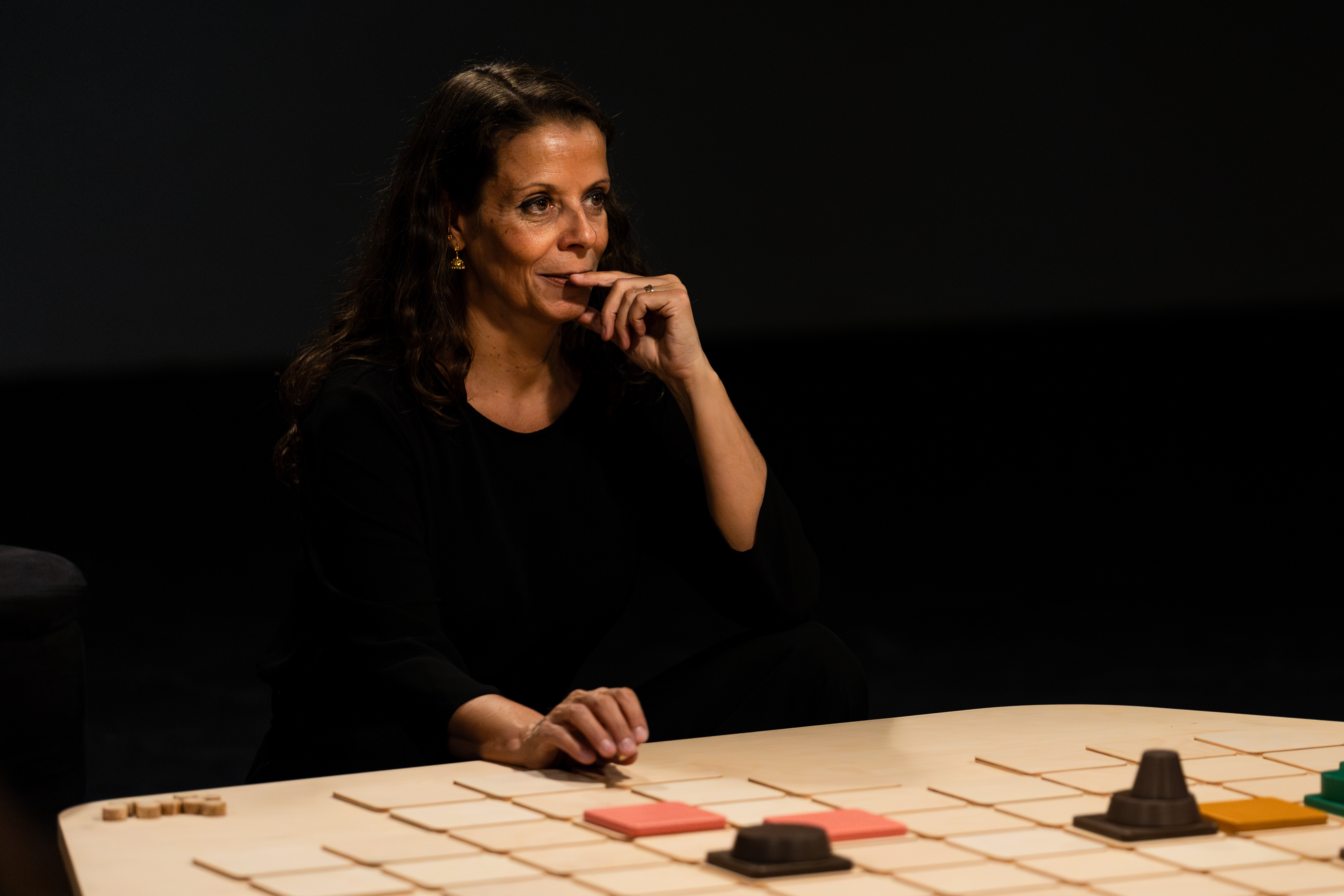
Cristina Galbiati - Common Land LAC Lugano - Photo G. Berruti -
Linda Fornara Bertona
The Non-Human takes to the stage