

In a fragmented world, cuisine remains one of the rare spaces where mutual understanding is still possible. This mediating role is far from marginal: history shows that many diplomatic moments have taken place around a shared meal, where conversation takes on a different tone, often more open and human.The table encourages listening. It creates a setting in which disagreements can be approached differently and distances can be reduced. In this sense, cuisine becomes a language of openness, requiring curiosity, acceptance of differences, and the ability to transform them into connection rather than division.
From this perspective, cooking does not simply mean producing food. It means participating in a broader conversation. A language is only as meaningful as the people who share it — and cuisine is no exception.
Cuisine is often described as codified. This reflects a historical reality. Culinary practices have been formalized over time, shaped by figures such as Auguste Escoffier, who helped organize and structure a shared body of techniques and repertoires.
In many ways, this codification functions much like that of a language. Cuisine is built on a vocabulary (ingredients), a grammar (techniques), and a form of syntax (the way flavors are composed and arranged). Like any language, it acquires meaning only through use, interpretation, and context.
Yet cuisine, like language, is never limited to its rules. Above all, it enables communication. And it is precisely this role that is becoming increasingly central: cuisine no longer merely expresses an identity, but brings together influences, practices, and individuals from different worlds. No language develops in isolation, and the same is true of cuisine. Culinary traditions have always evolved through borrowing, adaptation, and exchange. The history of the tomato, introduced to Europe in the 16th century through transatlantic trade, reminds us that what we consider “typical” is often the result of centuries of integration.
What distinguishes the current context is the intensity of these exchanges. Ingredients, techniques, and ideas now circulate at an unprecedented speed, transforming cuisine into a true space for dialogue.
This dynamic is reflected in professional paths as well. In the hospitality sector, international mobility has grown significantly. Professional kitchens today bring together people trained in very different cultural environments. Each person carries their own references, habits, and, in a sense, culinary “accents.”
And yet, despite this diversity, collective work remains possible. Why? Because beyond spoken languages, there is a common foundation: a shared culinary logic. In this sense, cuisine functions as a universal language, structured enough to create understanding, yet flexible enough to accommodate variation.
Recent developments have further strengthened this dimension. The digital dissemination of culinary knowledge has transformed the way skills are transmitted: techniques, recipes and presentation styles now spread almost instantly across the world. At the same time, environmental constraints and sourcing challenges are reintroducing the need for local adaptation. Chefs must work with what is available while continuing to draw inspiration from global references.
This tension reinforces the role of cuisine as a language: a system capable of translating different influences into specific contexts, rather than merely reproducing them.
In this context training chefs goes far beyond teaching techniques. It means enabling them to “speak” this language in all its complexity: understanding its foundations, but also its nuances, variations and cultural subtleties. This requires exposure to diversity, the development of interpretative abilities, and the skill to combine different influences while maintaining coherence. Training chefs today means creating professionals capable of dialogue — of understanding, responding, and creating together with other. By Karine Hyon Vintrou, Managing Director École Ducasse, copyright
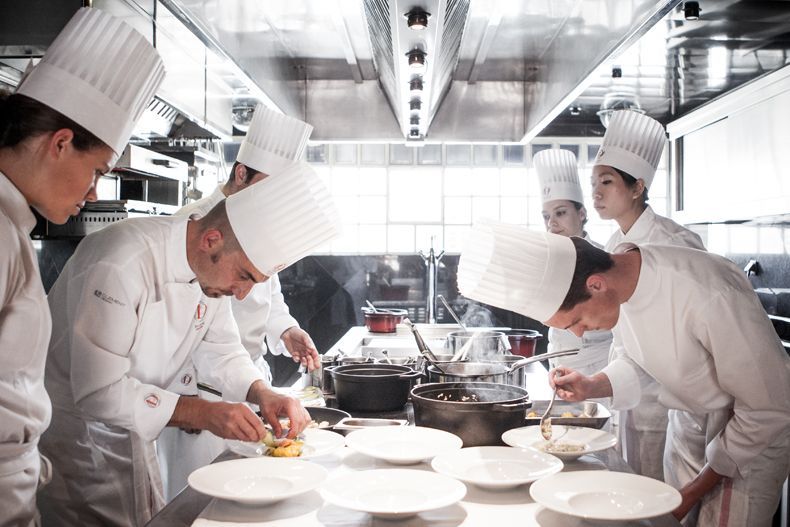
Chef, école Ducasse. Photo by école Ducasse - copyright
Di Karine Hyon Vintrou, Managing Director École Ducasse
At the Table to Listen