


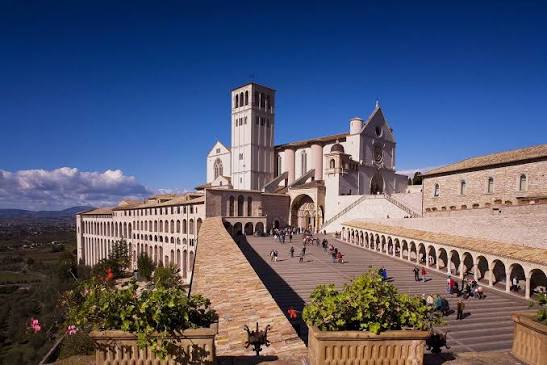


There are places where the journey begins long before you arrive. Assisi is one of them. All it takes is leaving the road behind and following the gentle contours of the Umbrian hills to sense a change: the pace slows down, the noise fades, and the gaze stretches into the distance. Here, luxury does not need to be ostentatious. It is made of space, silence, nature and time rediscovered. Nestled at the foot of Mount Subasio, Assisi preserves a spirituality that has crossed the centuries and does not belong exclusively to the religious sphere. It is a feeling perceived while walking among the pink-hued stones of the historic centre, entering the Basilica of Saint Francis and the beautiful Church of Saint Clare, pausing before a landscape, or simply watching the light change across the Umbrian hills.
The journey becomes a mindful pause dedicated to the well-being of body and mind. In the morning, an outdoor yoga practice invites participants to awaken the body through slow, fluid movements. No expertise is required: the goal is to listen rather than to achieve a performance. “Travelling is not only about discovering new destinations; it is about discovering yourself,” Francesco Profumi tells us, author of the book The Therapeutic Nature of Travel. Nourishing the Soul to Be Happy. A writer, a researcher of balance and, above all, a transformational coach, he is the founder of Be On Travel, part of the Nexum Group. His passion for exploration was born among the landscapes of Bolivia and the dusty trails of Baja California. His greatest dream is to cycle across South America.
“Be On Travel was born during the months when I could not travel because of the Covid-19 pandemic. When I was forced to stop, I realised that being on a journey actually means being present. I have struggled to identify myself as a writer; writing is difficult, but I want to continue. I will soon publish a new book entitled Travellers of the Soul, telling the stories of ten people who have transformed their journeys into life experiences,” Profumi explains. “And in the future? Investing in high-spending clients, but above all contributing to improving employees’ well-being through targeted coaching programmes, starting in Italy and also operating on a travelling basis: we go to them”. It is a multifaceted project that is also rooted in his family. “I believe that companies are not merely structures but living ecosystems, places where people should be able to grow alongside their results. My goal is to support organisations through change, transforming complexity into opportunities and building a culture that generates real impact,” adds his sister Ilaria, a strategic consultant, advisor and business coach. A seasoned manager as well as a loving mother, she has guided companies, networks and small and medium-sized businesses through complex processes of growth, reorganisation and innovation, supporting entrepreneurs and executives during delicate periods of transformation. As she awaits the publication at Christmas of her book on personal stories of female leadership, Ilaria admits without hesitation: “I am writing a practical guide on how to navigate the corporate world without letting it poison you!”And that is not all. “I want to invest in longevity. I want to be proactive and give meaning to life by helping people who are no longer very young and who, through appropriate physical activity and meditation, aim to age well. It is not about how many times you did everything perfectly; it is about how many times you found your way back to yourself”.
Breathing is one of the most immediate tools of mindfulness. This practice, from the English word meaning “awareness”, is a return to the present moment. It is the ability to observe what is happening: bodily sensations and thoughts. In a world dominated by speed, it becomes a precious form of mindful attention. Consider a simple grape, for example: “give value to every single gesture, listen, smell, taste before swallowing; give value to being present and, if the mind wanders, breathe and return to the here and now,” explains Rossella Polato, a Mindfulness expert and Yoga teacher. And then comes the practical part: immersing oneself in a cold spring. Our group experienced it during an exciting retreat at Paradiso 41, a green haven where the relationship with nature becomes an integral part of the experience and where the food prepared carries the fragrance of the vegetable garden. When the body comes into contact with cold water, it reacts instinctively: breathing may accelerate, muscles contract, and the mind searches for a way out. It is precisely at this moment that awareness becomes essential. Before entering the water, breathing should be calm and natural. Inhale gently through the nose and allow the exhalation to lengthen without forcing it. The principle is simple: do not fight the sensation; observe it. Hyperventilating or holding your breath during or immediately before immersion in cold water is not recommended, as these practices may increase risks, particularly in water. The cold spring becomes more than a test of endurance. It becomes a small ritual of presence: a few moments in which the outside noise fades away, leaving only the breath, the skin, the water and the awareness of one’s own body. During an interesting morning session, lying on a lawn surrounded by magnificent centuries-old trees, we are introduced to a particularly useful practice in today’s world: how to manage aggression through the concept of the “three brains”. To feel the impulse without being controlled by it. “Let us imagine the brain as a dialogue between three systems: the reptilian, limbic and cortical systems. The reptilian brain represents instinct which, in the face of a threat, prepares the body to react. The limbic system gives emotional meaning to what is happening, fuelling fear, anger or frustration. The cortex allows us to stop, observe and choose how to respond.
Managing aggression does not mean suppressing anger, but creating a space between the impulse and the action. Before speaking or reacting, slowing down the breath, stepping away from the situation for a few moments and naming the emotion can help reactivate the ability to assess the consequences. Above all, however, we must not forget to have compassion,” explains Attilo Gattucci, an emergency physician and psychotherapist, with expertise in pain management, disability and neurodivergence. “I am grateful to be here with you,” he begins. “I studied medicine because I wanted to enter into a relationship with others. Life is complex, but there is meaning in inhabiting that complexity”. Gattucci stresses the need to build a therapeutic path like a “tailor-made suit”, including the use of non-traditional medicines such as medical cannabis. “Cannabis has been recognised as a medicine in Italy for eight years. It is an extraordinary medicine because of its broad range of applications and high level of safety. It must be used consciously. Unfortunately, even today, the limitation lies on the medical side rather than with the patient…”.
At sunset, when Assisi lights up in golden hues, perhaps the most precious part of the stay arrives: the moment when there is nothing left to achieve. Only the opportunity to stop, observe and breathe. This is the most contemporary form of luxury: allowing yourself an authentic pause, choosing slowness, and rediscovering your own rhythm. In Assisi, amid Franciscan spirituality, the trails of Mount Subasio and the tranquillity of Agriturismo 41, the journey becomes an exercise in presence. And the return home inevitably carries something of that silence with it. Deluxu.it Magazine – Copyright